Your father has it. Your grandmother had it. Does that mean it's only a matter of time? Not necessarily. Here's what a DNA test can tell you about diabetes risk — and what it can't (and should never) do.
Your father was diagnosed with type 2 diabetes at 52. Your mother has thyroid trouble. Both your grandmothers had "sugar." So you have probably been told — maybe even told yourself — that it is only a matter of time.
It is one of the heaviest sentences in family medicine, and it deserves a better answer than "just watch what you eat." The truth is more hopeful, and more specific: in most people, type 2 diabetes is not written in stone by a single gene. It is a conversation between your genes and your daily life — and how early you join that conversation changes how it ends.
This is where DNA testing has earned a real, evidence-informed place: not to predict your fate, but to show your risk early enough to act — and increasingly, to show which foods, habits and medicines suit your body best. Here is what a DNA test can tell you about diabetes — and what it cannot.
💡 Key Insight
Think of your genes as a weather forecast, not a verdict. A forecast that says "high chance of rain" does not make you wet — it tells you to carry an umbrella. A DNA test works the same way for your metabolism: it flags where the rain is likely, so the decisions you make today decide whether you ever get soaked.
What "it runs in the family" actually means
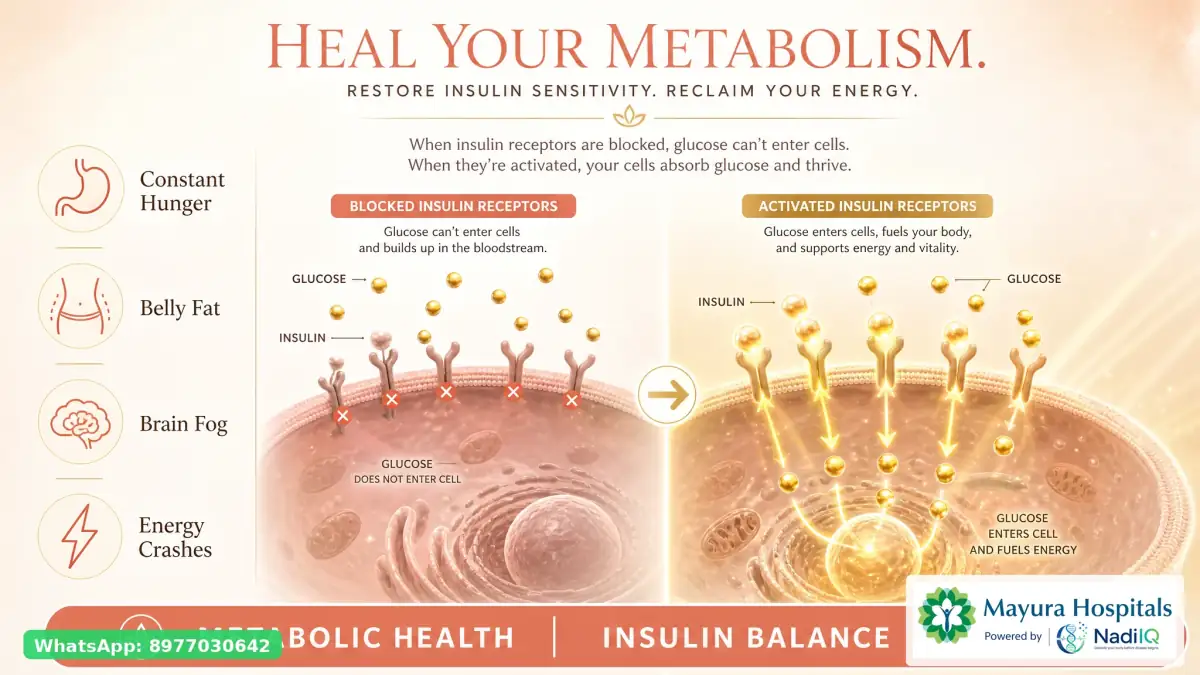
Type 2 diabetes is a polygenic condition — it is shaped by hundreds of common gene variants, each contributing a small nudge to how your body secretes insulin, responds to it, and stores fat. There is no single "diabetes gene" to inherit, which is exactly why the family story is more subtle than it sounds. As the American Diabetes Association explains in its genetics overview, some variants — a well-known example is TCF7L2 — tilt how the body handles glucose and insulin, but they act in combination, and they act alongside your life.
Family history, though, remains one of the strongest signals we have. Clinical estimates suggest that if one biological parent has type 2 diabetes, lifetime risk is roughly 40%; if both parents are affected, it rises to around 70% — and research estimates that a family history raises the incidence of type 2 diabetes roughly two to four times. Around six in ten people diagnosed with type 2 diabetes have at least one family member with the condition. Cleveland Clinic's clinical overview frames the mechanism well: hundreds of common variants set a baseline risk, which daily life then modifies heavily in either direction.
And here is the part the family story usually leaves out: none of that means the diagnosis is guaranteed. In the landmark Diabetes Prevention Program, people at high risk who changed their diet, moved more and lost just 5–7% of their body weight cut their risk of developing type 2 diabetes by more than half. The genes leaned one way; their daily decisions leaned the other — and the decisions won.
Genes load the gun. Daily life decides whether it is ever fired. That single sentence is why knowing your risk early is worth so much: it is the difference between reacting to a diagnosis and quietly dismantling it before it arrives.
Why "early" is the whole game — especially in India
Type 2 diabetes rarely arrives as a surprise attack. It usually spends years in a silent pre-stage — prediabetes — where blood sugar is higher than normal but not yet diagnostic, and where damage to blood vessels is already beginning. That stage is reversible, often fully, and it is exactly the stage most people miss, because it has no symptoms.
In India, the stakes are higher: type 2 diabetes tends to appear about a decade earlier, and at lower body weights, than in Western populations — which is why waiting for "classic" risk signals (like obvious obesity) before getting screened is a losing strategy here. As orientation points (your doctor will set your personal targets): a normal fasting reading is generally under 100 mg/dL, 100–125 mg/dL falls in the pre-diabetes range, and 126 mg/dL or higher on two occasions points toward diabetes.
For anyone with a family history, professional guidelines recommend talking to a doctor about starting screening earlier and more regularly than the general population. A yearly HbA1c or fasting glucose, starting from your 30s (or earlier if the family pattern is strong), takes minutes and buys years of options — and it is the foundation of the diabetes and metabolic care our team practises. If you want the full context on the metabolic basics, our guide to reversing pre-diabetes naturally is a good companion read.
What a DNA test can tell you
A well-chosen, doctor-reviewed genetic test is not a gimmick; used properly, it adds a layer of personalisation that standard tests cannot provide:
- Your personal risk signals for metabolic disease. Panels read the gene variants tied to glucose handling, insulin function, appetite and weight regulation — the same systems that decide how loudly your family history will speak. Seeing that you carry a higher-risk pattern is a powerful, personal reason to start screening and acting years earlier.
- How your body handles food. Nutrition and food-response traits — salt sensitivity, fat taste, appetite style, food preferences — explain why the diet that transformed your colleague does nothing for you. This is how a meal plan becomes yours rather than a generic chart.
- How you respond to medicines. Pharmacogenomic traits show how your body metabolises common medicines. For someone looking at a lifetime of prescriptions, this is quietly revolutionary: it can make prescribing more precise, reduce trial-and-error rounds, and help your doctor find the medicine that works for your biology sooner.
- What you may pass on. Carrier and inherited-condition screens (including conditions common in India such as thalassemia and G6PD deficiency) matter when planning a family — and they are a reminder that risk is shared, which is why a parent's diagnosis is often the moment for the whole household to get informed.
One more feature that rarely makes the marketing: your DNA does not change. This is a once-in-a-lifetime test. The report stays valid for life and gets re-read as your care — and the science — evolves.
What a DNA test cannot do
A DNA test can…
- Map your genetic risk profile for metabolic conditions
- Guide when and how often to screen, alongside your doctor
- Personalise nutrition and fitness choices to your biology
- Inform which medicines suit you — applied by your doctor
- Flag inherited conditions relevant to your family
A DNA test cannot…
- Diagnose diabetes (that needs blood tests — HbA1c, fasting glucose)
- Guarantee you will or will not develop the condition
- Replace diet, movement, sleep or medical care
- Change your medicines by itself — never self-adjust
- Delete the role of daily habits (they matter as much as genes)
The honest summary: a DNA test is a risk map, not a diagnosis — and a map is only useful when someone qualified walks it with you.
The real question: "Will I be on medicines forever?"
It is the question underneath every other question, and it deserves a careful answer rather than a slogan.
For type 2 diabetes, the trajectory is not fixed. When it is caught early — at the prediabetes stage, or early in diagnosis — intensive lifestyle work under medical supervision often reduces the need for medicines, and in a meaningful share of people, can bring blood sugar into a healthy range without medication for months or years. That outcome has a clinical name — remission — and it is most reachable for those who act early, lose weight meaningfully, and keep the change going.
What genetic testing adds to this picture is precision in both directions: it can sharpen your prevention plan (what to prioritise for your body), and it can make medicine decisions better when medicines are needed — right molecule, right fit, fewer failed trials. Fewer wrong turns, earlier.
What it does not do — and what no test, supplement or programme should ever promise — is take decision-making away from your doctor. Blood sugar medicines are adjusted only with medical supervision. The goal worth working towards is not "medicines forever"; it is the fewest medicines, at the lowest doses, for the shortest time your body allows — and that goal is built with your care team, using every tool available, including your genes.
If diabetes runs in your family: your 7-point action list
- 1. Map the history. Write down who in the family has diabetes or prediabetes, on which side, and at what age they were diagnosed. A parental diagnosis under 50 is an especially strong signal. Bring this page to your next appointment.
- 2. Screen earlier than feels necessary. Ask your doctor about starting HbA1c and fasting glucose checks from your 30s — earlier with a strong family history. One annual test beats years of guessing.
- 3. Track the numbers that move first. Waist circumference, weight and fasting readings change long before a diagnosis. Trends, not single readings, are the story.
- 4. Move daily. Target about 150 minutes a week of brisk activity — and add strength training twice a week. Working muscles take up glucose without waiting for insulin.
- 5. Eat for a steadier 24 hours. Protein-first meals, plenty of vegetables and fibre, low-glycemic staples, and an earlier, lighter dinner. If evening reads and morning reads confuse you, our guide to the dawn phenomenon explains why mornings misbehave — and how to fix them.
- 6. Protect sleep and stress. Short sleep and chronic stress raise insulin resistance directly. A regular 7–8 hour window is metabolic medicine.
- 7. Consider a doctor-interpreted DNA test. If you want to move from generic advice to your body's actual levers — and get the medicine-response picture before medicines become a long-term reality — this is the deep end of personalisation.
Add one more item for the household: when one adult in a family screens and knows their risk, the rest of the family gets a head start too. Risk runs in families; so does prevention.
A DNA test that's read for you — not dumped on you
At Mayura Hospitals, the Comprehensive Genetic DNA Test is built around exactly this philosophy. It is a saliva-based test — no needles, no fasting — that reads 200+ personal traits across 13 health areas, including a large Glucose, Insulin & Diabetes Protection section, Nutrition & Food Response, Fitness & Performance, and Medicine Response (pharmacogenomics). It adds 11 composite health indices and 13 inherited-condition screens — and unlike raw direct-to-consumer data dumps, it is reviewed with you by a Mayura doctor and built into your personalised plan (Food · Fasting · Fitness) alongside your prescribing doctor. One test, valid for life, kept in your health record where it can keep working for you.
Does diabetes run in your family?
Turn family history from a worry into a plan. Talk to Mayura's team about early screening, a doctor-reviewed DNA test, and a personalised metabolic programme — and find out what your genes actually mean for the road ahead.
Book an AppointmentFrequently Asked Questions
Can diabetes be prevented if it runs in my family?
In many cases, yes — or at least delayed by years. Family history raises your baseline risk, but large prevention trials show that lifestyle changes (weight loss of 5–7%, regular activity, better sleep and food quality) can cut the risk of developing type 2 diabetes by more than half, even in high-risk groups. The earlier you start, the more of that protection you get — which is why early screening, not worry, is the right first step.
How is genetic risk different from a blood sugar test?
A blood test tells you what your sugar is doing right now; a genetic test tells you what your body is likely to do over a lifetime if nothing changes. They answer different questions — and they work best together. Genetics can push you to screen earlier (during the silent prediabetes years), while HbA1c and fasting glucose track how you are actually doing.
Is a saliva-based DNA test accurate?
Saliva is a standard, well-validated sample for genetic testing — the science is in the laboratory analysis and interpretation, not the collection method. Accuracy depends on the quality of the panel, the accreditation of the lab, and whether a clinician reads the result with you. Prioritise accredited, doctor-interpreted tests over raw data dumps.
Can a DNA test tell me which diabetes medicine suits me?
It can inform that decision. Pharmacogenomic traits reveal how your body metabolises certain medicines, which helps your doctor choose and dose treatments more precisely — reducing trial-and-error. It never replaces medical judgement, and medicines are never started, stopped or adjusted without your doctor's guidance.
I already have diabetes — is a DNA test still useful for me?
Yes. The medicine-response insights can refine your treatment; the metabolic traits help personalise nutrition and fitness; the carrier screens matter for your family; and the report becomes a lifelong reference as your care evolves. For many patients, it is the moment their plan stops being generic and starts being theirs.
Your family history is not a verdict. It is a head start — if you use it early. Screen on time, move daily, eat for steadiness, and let your genes inform the plan rather than dictate it. That is how the family story changes.
Key Takeaways
- Evidence-based insights from our medical experts
- Practical steps you can apply to your health journey
- Part of our commitment to metabolic health education
Written by
Dr. Mayura
Healthcare professional at Mayura Hospitals, specializing in metabolic health and the 3F Protocol.