Hypothyroidism affects roughly one in ten Indian adults and peaks between 46 and 54 — yet it is usually discovered as a 'borderline' TSH nobody acts on. Here is how Siddha medicine for thyroid approaches the root cause, what the evidence honestly supports, and a 12-week plan for working professionals.
Your TSH came back at 6.4. The report says "borderline", your doctor says "let's watch it", and you go home with a number instead of an answer. Meanwhile the weight creeps up on the same food you have eaten for years, you sleep eight hours and are still exhausted by 3 p.m., and your hair is thinning.
That is how thyroid problems usually arrive in midlife — not as a dramatic illness, but as a slow, deniable drift. Here is what hypothyroidism is, why it clusters in working professionals between 35 and 55, and what Siddha treatment for thyroid actually involves.
What Is Hypothyroidism — and Why Is It So Common in India?
Hypothyroidism is an underactive thyroid gland. The butterfly-shaped gland at the base of your neck makes T3 and T4, the hormones that set the pace of almost every cell. When production falls, everything slows: heart rate, gut motility, fat burning, hair and skin turnover, even thinking speed.
India carries more of this than most people realise. A multi-centric study across eight Indian cities found hypothyroidism in 10.95% of adults — 15.86% of women versus 5.02% of men — peaking in the 46–54 age band at 13.11% (Indian Journal of Endocrinology and Metabolism, 2013). A study of postmenopausal women in urban north India reported prevalence as high as 27.3% (Journal of Family Medicine and Primary Care, 2024).
Most of those cases are subclinical: TSH is raised, T3 and T4 still look normal, and the report is filed away as "borderline" — the version that quietly erodes energy, mood and metabolic health for years. Watch for a cumulative pattern: weight gain on a diet that used to work; fatigue sleep does not fix; feeling cold when others are comfortable; thinning hair; constipation; irregular periods.
Why Thyroid Problems Surface in Your 30s, 40s and 50s
The midlife hormonal shift
Oestrogen and progesterone do not act on the thyroid directly, but they shape how much thyroid hormone is carried in the blood and how much free hormone reaches your cells. As these fluctuate through perimenopause, a previously compensated thyroid weakness becomes visible — one reason the 46–54 band has the highest prevalence in the Indian data.
Chronic stress and the cortisol–thyroid axis
Sustained stress raises cortisol, and cortisol suppresses conversion of T4 into the active T3. You can have a normal-looking T4 and still be functionally low on active hormone. Add sleep loss, skipped meals and late screens, and the conversion pathway takes a second hit — the commonest pattern in working professionals.
Sleep debt, autoimmunity and the iodine paradox
TSH follows a daily rhythm that peaks in the small hours; rotating shifts and 5–6 hour nights flatten it, and poor sleep worsens insulin resistance, which feeds back into thyroid function. The commonest cause of hypothyroidism in India is Hashimoto's thyroiditis, an autoimmune attack on the gland. Do not self-prescribe high-dose iodine or kelp.
The Thyroid–Metabolism Connection: Why Weight and Blood Sugar Follow
Thyroid hormones set your metabolic rate. T3 and T4 regulate basal metabolic rate and how your body handles fat and glucose. When they fall, resting energy expenditure falls too — which is why "calories in, calories out" stops working. The "calories out" side of the equation has quietly shrunk.
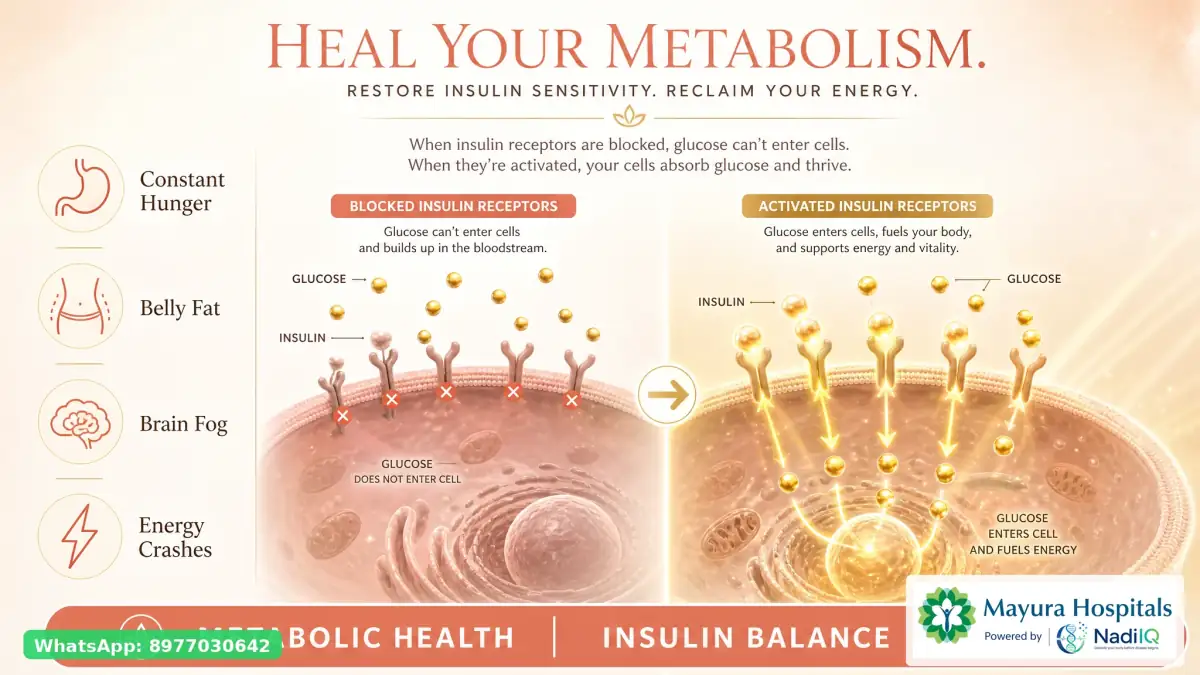
A rising TSH matters even before T3 and T4 move. A large analysis using the Metabolic Score for Insulin Resistance (METS-IR) found that higher TSH levels were positively associated with insulin resistance in the general population, independent of the thyroid hormones themselves (BMC Endocrine Disorders, 2024).
The thyroid–diabetes overlap runs both ways. A narrative review found hypothyroidism — including subclinical — consistently associated with weight gain, raised LDL and triglycerides and higher prevalence of metabolic syndrome (Cureus, 2025). Eighteen years of follow-up in the Tehran Thyroid Study found declining free T4 predicted metabolic syndrome (International Journal of Endocrinology and Metabolism, 2025). If you have been told you have pre-diabetes, PCOS or stubborn central obesity, your thyroid deserves a look — and vice versa.
How Siddha Medicine Views Thyroid Disorders
Siddha medicine, the classical Tamil system practised across Tamil Nadu, Kerala and parts of Telangana, does not describe a "thyroid gland" in modern terms. It reads the cluster — coldness, heaviness, sluggishness, swelling, dry skin, slow digestion, low mood — as a Vatha-Kabham disturbance: Vatha (air and movement) and Kabham (water and structure) deranged together, with the metabolic fire suppressed.
Classical texts describe the same picture through Agnimandya (impaired digestive fire) and Medo-Dushti (disorder of fat tissue). Poorly digested food produces ama, metabolic residue that clogs channels and slows everything downstream, including hormone conversion. Modern medicine has reached a version of the same idea through the gut–thyroid axis: the gut converts a share of T4 into active T3.
Practically, Siddha treatment for thyroid is not aimed at forcing a number down. It aims to restore the conditions under which the gland can work — digestion, circulation, sleep, stress load and tissue nourishment. Two people with a TSH of 6.4 will not get the same plan: one may be thin, anxious and constipated, the other heavy, cold and sleepy with a fatty liver.
Key insight: A "borderline" TSH is not a harmless number. Higher TSH is associated with insulin resistance even when T3 and T4 look normal — so the fatigue and weight gain you blame on age may be the same metabolic drift that leads to pre-diabetes. Treat the pattern, not just the report.
What Siddha Treatment for Thyroid Actually Involves
Assessment before prescription. A proper consultation begins with naadi (pulse) reading, tongue and digestion assessment, sleep and stress pattern, menstrual history where relevant, and a review of your existing blood reports — TSH, free T3, free T4, anti-TPO, vitamin D, B12, ferritin, fasting glucose, HbA1c and lipids.
Internal medicines. Depending on the presentation, a Siddha physician may prescribe kudineer (decoctions), chooranam (powders), tablets and, in specific cases, purified mineral preparations. Herbs used traditionally for thyroid and metabolic sluggishness include Kanchanar Guggulu, Ashwagandha, Triphala and Guggulu. Two caveats: mineral-based preparations must come from a qualified practitioner using properly purified, quality-tested medicines; and herbal medicines can interact with levothyroxine, so both your physicians should know what you take.
External therapies. Where there is heaviness, stiffness or poor circulation, therapies are used alongside internal medicine: thokkanam (Siddha deep-tissue manipulation), varmam (work on vital points), warm medicated oil and kizhi (herbal poultice). These do not treat the gland directly; they improve circulation, muscle tone and sleep. Our guide to uzhichil therapy for desk-job back and neck pain explains how these therapies are delivered in practice.
Pathiyam, review and coordination. In Siddha, pathiyam — diet and daily routine — is not an optional add-on; it is half the treatment. Reviews typically happen every four to six weeks, with repeat thyroid tests every eight to twelve weeks. If you are on levothyroxine, the aim of Siddha care is to improve how your body uses the hormone and to reduce the drivers of the disease — not to stop your prescription. Any change to thyroid medication must be made by the prescribing doctor after a fresh blood test.
What the Evidence Says — Honestly
Encouraging. A randomised controlled trial of an add-on Whole System Ayurveda protocol in patients whose primary hypothyroidism was not well controlled on stable levothyroxine found measurable improvements in the Ayurveda group versus control (Journal of Ayurveda and Integrative Medicine, 2024). It is a small trial, but a randomised design in the population that matters: people already on conventional treatment who still feel unwell.
Preliminary. Kanchanar Guggulu has been studied in subclinical hypothyroidism, including with levothyroxine, with reported reductions in TSH; most studies are small and several are ongoing. Ashwagandha has shown modest thyroid-hormone effects in small trials. These are signals, not proof.
Not established. There is no robust evidence that any herbal protocol reliably cures Hashimoto's thyroiditis or permanently replaces levothyroxine. What traditional medicine can realistically claim is support: better symptom control, better metabolic markers, better sleep and digestion, and a lower medication requirement in some cases.
Safety. Herbal medicines are not automatically safe. Ashwagandha can be unsuitable in autoimmune flares and pregnancy; high-dose iodine and kelp can worsen thyroid disease; some preparations interact with anticoagulants and thyroid medication.
Siddha and Conventional Care: How They Fit Together
Siddha medicine
- Treats the whole pattern — digestion, sleep, stress, constitution
- Individualised internal medicines and external therapies
- Strong emphasis on pathiyam (diet and daily routine)
- Works on the drivers: agni, insulin resistance, sleep, stress
- Used alongside, not instead of, your prescriptions
Conventional care
- Precise diagnosis through TSH, free T3/T4 and anti-TPO
- Levothyroxine replaces the missing hormone directly
- Fast, reliable correction of the hormone deficit
- Essential in pregnancy, heart disease and severe hypothyroidism
- Does not by itself address diet, sleep or insulin resistance
The sensible arrangement is not a contest: levothyroxine corrects the hormone deficit, while a Siddha protocol addresses the metabolic soil in which the disease grew. Many patients do best on both, coordinated by two clinicians who know what the other is doing.
A 12-Week Root-Cause Plan for Working Professionals
This is a framework, not a prescription, designed around a desk job and limited time — and it assumes you are under a qualified physician's care.
Weeks 1–2: Baseline and clean-up
- Get a full panel: TSH, free T3, free T4, anti-TPO, vitamin D, B12, ferritin, fasting glucose, HbA1c, lipids — without a baseline you cannot tell what worked.
- Fix a sleep window — same bedtime and wake time, seven days a week, 7–7.5 hours. This is the highest-yield change for T4-to-T3 conversion.
- Stop self-prescribed iodine, kelp and unverified herbal capsules.
- Book a proper Siddha consultation, and start a 12-hour overnight eating window — dinner by 8 p.m., breakfast at 8 a.m.
Weeks 3–6: Build the metabolic floor
- Begin internal medicines exactly as prescribed, and external therapies if advised — typically one or two sessions a week.
- Protein at every meal: eggs, dal, curd, paneer, fish, chicken, sprouts. A palm-sized portion each sitting protects muscle, and muscle is where glucose goes.
- Ten minutes of strength work three times a week — squats, wall push-ups, resistance bands. This is not optional if you want the scale to move.
- Walk 8,000–10,000 steps daily, cut liquid sugar, and add ten minutes of slow nasal breathing to lower cortisol and support T3 conversion.
Weeks 7–12: Consolidate and re-test
- Repeat thyroid function tests at week 10–12 and review with both physicians.
- Do not change levothyroxine doses yourself — if your numbers improved, the dose decision belongs to your prescribing doctor.
- Review digestion, energy, sleep and cycle regularity — symptoms often move before the numbers.
- Reassess waist circumference and HbA1c alongside TSH. If the thyroid is improving but the waist is not, the insulin-resistance side needs more work.
What to Eat — and What to Limit
Eat more of: warm, freshly cooked meals over cold, raw and refrigerated food; protein and fibre together at every meal (dal and vegetables, eggs and greens, fish and millet); millets in place of polished rice at some meals, to flatten the glucose curve; iodine from food rather than supplements — normal iodised salt, curd, eggs, seafood; selenium and zinc foods such as one or two Brazil nuts a day and pumpkin seeds; and the classical digestive spices — ginger, turmeric, cumin and black pepper.
Cut back on: very large daily quantities of raw cruciferous vegetables (cooked is fine — the goitrogen concern is overstated at normal portions); excess processed soy; and ultra-processed snacks, refined flour and deep-fried food, the strongest drivers of insulin resistance in the Indian diet.
Who Should Be Careful
Get medical clearance first
- Pregnancy or planning pregnancy — thyroid dosing must be managed by an obstetrician and endocrinologist
- Known heart disease, arrhythmia or uncontrolled hypertension
- Severe hypothyroidism, or a rapidly enlarging or nodular gland
- On anticoagulants or multiple prescription medicines
Red flags — see a doctor promptly
- Sudden weight change, palpitations, tremor or heat intolerance
- A rapidly growing neck swelling, or difficulty swallowing or breathing
- Severe depression, confusion or extreme drowsiness
- New chest pain or breathlessness
Related Reading: Weight, Insulin Resistance and PCOS
If your thyroid problem has come with weight gain you have been fighting for years, our guide to Siddha medicine for weight loss covers the metabolic side in more depth, and the insulin resistance guide explains the mechanism linking the two. Women dealing with irregular cycles alongside thyroid symptoms may find the PCOS root-cause plan useful, since PCOS and thyroid disease frequently overlap.
Frequently Asked Questions
Can Siddha medicine cure hypothyroidism permanently?
No responsible practitioner will promise that. Siddha medicine can improve symptoms, support metabolic function and, in some cases, reduce how much thyroid hormone you need — but Hashimoto's is an autoimmune condition with no established cure in any system. What Siddha treatment can realistically do is address the drivers: digestion, insulin resistance, sleep, stress and diet.
Can I take Siddha medicine along with levothyroxine?
Yes, in most cases, but only with both physicians informed. Levothyroxine is usually taken on an empty stomach in the morning, and herbal medicines are timed around it to avoid absorption interference. Never stop or reduce levothyroxine on your own — abrupt withdrawal can be dangerous.
How long before I see results?
Digestion, sleep and energy often improve within three to six weeks. Weight, hair and cycle changes take longer — typically three to six months — because hair and metabolic tissue turn over slowly. Thyroid tests are usually repeated at eight to twelve weeks.
Will Siddha treatment help me lose weight?
It can help, but not by itself and not quickly. Correcting an underactive thyroid removes one brake on your metabolism; restoring sleep, protein intake and muscle mass removes others. A steady loss of 0.25–0.5 kg a week holds far better than crash-diet weight loss.
Ready to treat the cause, not just the number?
If your TSH is "borderline", your energy is not, and the weight will not move, a structured root-cause assessment can tell you what is actually driving it — and build a plan that works alongside your existing treatment.
The Bottom Line
Hypothyroidism affects roughly one in ten Indian adults, peaks in the 46–54 age band and hits women three times as often as men — yet it is most often discovered as a "borderline" number nobody acts on. That number matters, because a rising TSH travels with insulin resistance, weight gain and a higher risk of metabolic syndrome — and the fatigue you blame on your job may be treatable.
Siddha medicine approaches thyroid disease as a whole-body pattern — suppressed digestive fire, deranged Vatha and Kabham, and the daily habits that keep them that way. Its greatest strength is the part modern medicine often skips: diet, sleep, stress and routine, individualised to you. Used alongside — never instead of — your prescribed treatment, and with repeat testing, it can change how you feel.
Key Takeaways
- Evidence-based insights from our medical experts
- Practical steps you can apply to your health journey
- Part of our commitment to metabolic health education
Written by
Dr. Mayura
Healthcare professional at Mayura Hospitals, specializing in metabolic health and the 3F Protocol.